
What Finland Can Learn from Norway About the Clean Transition with Scarce Resources
September 22, 2026
Minna Näsman
When traveling from the shores of the Gulf of Finland to the coast of the Arctic Ocean, several assumptions about the world are turned upside down. Seen from Kirkenes, Oulu is in the middle of Finland, and the speeches about energy transition that are delivered inside Helsinki metropolitan area seem to point in the right direction, but.
What is not always fully recognized is what advancing the clean transition in arctic regions actually requires. It must be carried out without abundant forests, electricity grids, or railway infrastructure. It must be implemented alongside people whose needs cannot be ignored, and within an environment that is both beautiful and fragile.
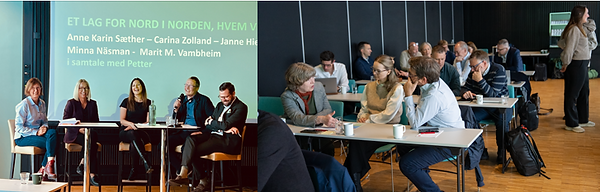
In September, the Northern Norwegian energy cluster Energi i Nord invited the JustH2Transit project to its annual members' meeting in Kirkenes to reflect on the differences and similarities between the clean transitions taking place in Norway, Sweden, and Finland.

Comparing experiences suggested that Norway is currently at a stage where the main discussion concerns building new clean energy production. Sweden and Finland have already moved on to addressing the challenges created by new forms of energy consumption.
Full transition with limited resources
Across all three countries, the key constraint appears to be electricity transmission. Finland seems to struggle the least with this issue. On the other hand, Sweden has already had time to innovate more effective processes for allocating limited grid capacity. In Finland, prioritization of the grid capacity is highly topical. In Norway, attention is also focused on what can be done when sufficient grid infrastructure is unavailable, but ports and airports are plentiful. Yet difficult circumstances may also encourage people in Norway to stick with established solutions, especially when fossil resources remain widely available.
The hydrogen transition remains an industrial transition even when the scale becomes smaller. In the small municipalities of the North, economic vitality is based on fisheries, agriculture, and reindeer husbandry. The first two sectors require clean maritime fuels and fertilizers. These can be produced from hydrogen and air, without carbon dioxide emissions.
Hydrogen production can also support food production through its by-products, namely heat and oxygen. These resources can enable the creation of new fish farms and greenhouses. Bio-based carbon dioxide derived from agricultural residues can be used in the production of aviation fuels, helping support air transport, which, together with maritime transport, is practically a substitute for railways in these regions.

Even a small municipality can host large-scale industry. The mining operations visible around Kirkenes are an example. At the same time, reindeer husbandry depends on extensive, undisturbed land areas. Municipalities in Northern Norway that supply a significant share of Europe’s natural gas are accustomed to having an influence far greater than their size would suggest. Consequently, major questions concerning the effects of large industrial investments on the climate, the environment, and society cannot be escaped simply by retreating to a small village on Europe’s northern edge.
Critical infrastructure in strategic locations
Even more remotely, practically in the middle of the wilderness, one may find critical energy infrastructure whose daily operation serves as a reminder of the new tensions between neighboring countries. At the Skogfoss hydropower plant, we met Mads Haneborg, who explained that he had previously developed a software startup in California. He now finds it deeply rewarding and meaningful to be responsible for a physical service that supplies electricity to tens of thousands
of households.

This is true despite the fact that the power plant is located virtually on the border between Norway and Russia. Today, that means Mads must carefully keep track of every visitor entering and leaving the site to ensure that no unauthorized individuals slip into the group.
A visit to the border marker standing in the middle of the river serves as a reminder that the clean transition is a challenge that transcends national borders. Resources are shared, and the consequences of their use spread through both the atmosphere and the environment, affecting everyone.
Shared challenges call for joint solutions
The strongest takeaway from the visit is that it makes little sense to address these issues solely at the local, or even national, level. Doing so would mean losing opportunities to create solutions that are only possible on a larger regional scale, such as Europe’s strategically important northern frontier. It would also mean missing the chance to learn from each other’s struggles and to be inspired by
each other’s successes.
For Finland, cross-border cooperation in the North provides opportunities to better understand which administrative solutions have worked well so far and which deserve further development. Both Finland and Sweden benefit from ensuring energy transmission connections across national borders, while friendly competition drives the development of large-scale low-carbon industry.
Norway can easily be seen as a society-sized laboratory of just the right scale for the hydrogen transition. In its early stages, this transition requires scaling up new technologies and industrial symbioses.
Furthermore, Government Pension Fund of Norway has the capacity to finance Nordic technology projects across the Nordic region. Given this, it seems quite straightforward that cooperation between the Nordic countries can strengthen local economies in Europe’s northernmost regions and, through that, contribute to the resilience and prosperity of the continent as a whole.
Minna Näsman
Interactions Manager, JustH2Transit